

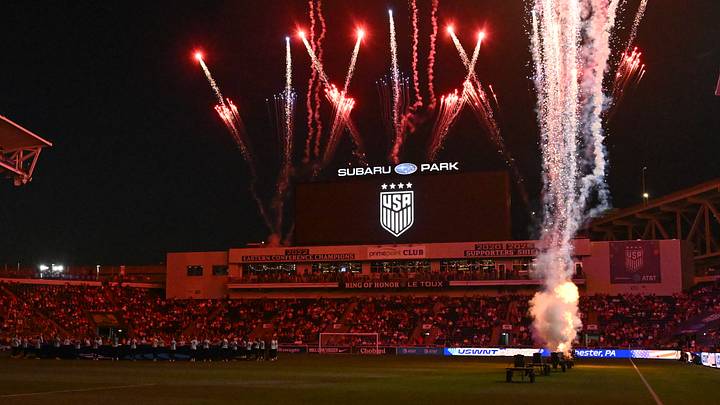
Even though the USWNT has yet to book their flight to Brazil for the 2027 Women's World Cup, their destiny for 2031 is now set in stone. On Monday, the hosts for the 2031 and 2035 editions of the Women's World Cup were confirmed by FIFA. The 2031 edition will be hosted by the United States, Jamaica, Mexico, and Costa Rica; it will be the first Women's World Cup to be held on North American soil since Canada hosted in 2015.
Four years later, it will be Europe's turn to host the tournament. England, Wales, Scotland, and Northern Ireland will be the co-hosts for that tournament. All four hosts for both tournaments will qualify automatically. Barring a major qualifying shock, the USWNT would make their 11th appearance at the tournament. Costa Rica and Jamaica would also have the opportunity to extend their own qualification streaks with the 2031 tournament, while Mexico could either make it two appearances in a row or celebrate their first appearance in 16 years on home soil.
Bigger than ever: new challenges await the USWNT now and over the four years post-2027
The USWNT might be one of the world's top women's soccer teams, but the path to their traditional dominance could be longer and tougher than ever. Simply put, the 2031 edition will be the first to feature 48 teams. That expansion will come just two editions after the number of participating teams increased to 32. But even with 32 teams, many nations are still taking the opportunity to claim their place in the women's soccer picture.
It’s official!
— U.S. Soccer (@ussoccer) November 23, 2026
The 2031 FIFA Women’s World Cup has been awarded to the United States, Mexico, Costa Rica and Jamaica.
📰 https://t.co/ryCEFVYInL pic.twitter.com/x6ZBe7m3Rv
Of the 18 teams that have already secured their spot in next summer's tournament, two of them will be making their Women's World Cup debut; those countries are Algeria and Malawi. Even then, 11 nations could still make their debut at this tournament, three of which have qualified for the interconfederation playoff. The USWNT will be facing another one of those teams this week in El Salvador.
At the same time, two of the eight nations that made their Women's World Cup debut in 2023 will make a return trip to the competition in 2027. Two nations that could still make a return trip after debuting in 2023 are in the CONCACAF W Championship; both Haiti and Panama can make return trips to the Women's World Cup with quarterfinal victories or a run in the inter-confederation playoff.
World Cup debutants should not be overlooked
And it's not like all of the debutants were quick work for their fellow group stage opponents. Morocco finished second in their group in their Women's World Cup debut, defeating South Korea and Colombia en route to a knockout-round berth. Meanwhile, Portugal's debut ended one goal short of knocking the USWNT out of the tournament, settling for a 0-0 draw with the Americans, though the USWNT had previously beaten fellow debutants in Vietnam 3-0.
While Haiti and Ireland were two of the debutants to miss the knockout round in the 2023 Women's World Cup, both made their case by causing significant chaos in their respective groups. Two of Haiti's defeats were only the case because of a penalty, while Ireland was able to secure a draw against Nigeria.
That big picture will more than certainly take a larger role in an expanded World Cup. As the aforementioned national teams string World Cup appearances together and gain experience, they will eventually be able to consistently stand toe-to-toe with superpowers like the USWNT. In fact, the USWNT's contest against El Salvador, who have never qualified for a Women's World Cup, might give them a glimpse of what a further-expanded international women's soccer scene could mean for their continued push for championships.
What a home World Cup could look like
While no official host cities have been named and no official match schedule or bracket has been laid out, it is possible to make a few assumptions.
In terms of host cities, FIFA's summary of its view on the United States' joint bid names 14 U.S. cities that could host Women's World Cup matches. FIFA also noted that the bid provided them with the opportunity to pick and choose which cities end up hosting games. The U.S. cities listed in the official report include Kansas City, Nashville, and even Washington.
A total of 20 cities were named through FIFA's findings.
 Add us as a preferred source on Google