

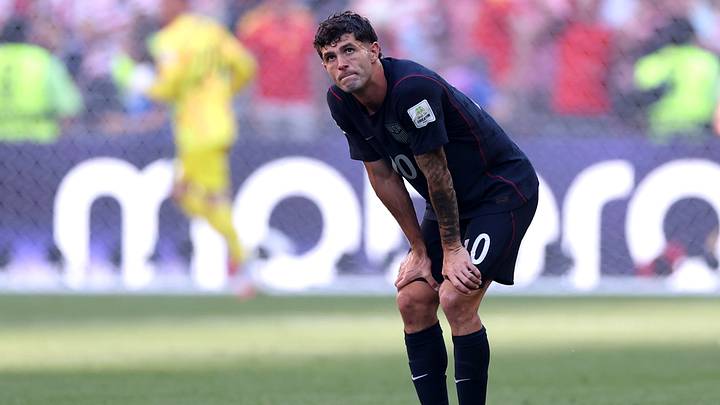
Following its 4-1 loss to Belgium, the USMNT has a four-year wait until the next World Cup. Once again, the Americans failed to get beyond the Round of 16, something the USMNT hasn’t accomplished since 2002. Of course, the goal for the 2030 World Cup will be to take that next step, reaching the quarterfinals or better.
Naturally, there is plenty of uncertainty around what the next four years will look like and how the USMNT can finally take that next step forward on the world stage. Amidst all of the twists and turns that await, here are the four most important questions for the USMNT that will likely define the next four years, as we all wait for the 2030 World Cup.
Who’s the right coach?
This is perhaps the most important question: who will lead the USMNT for the next four years? There were rumblings during the early part of the World Cup that U.S. Soccer and Mauricio Pochettino were considering a pact that would allow the Argentine manager to have a full four-year cycle with the USMNT. But whether that actually happens remains to be seen.
Mauricio Pochettino on his future: “I will now rest and relax a bit, we'll see what the decision is from the federation and from us”. 🇺🇸 pic.twitter.com/14EPX0MfZ4
— Sleeper Football (@SleeperFooty) July 7, 2026
Would Pochettino be happy to extend his hiatus as a club manager for another four years when he’s been accustomed to coaching some of Europe’s top teams? Does a non-competitive loss in the Round of 16 change the way the U.S. Soccer Federation views Pochettino? Equally important, if it’s not Pochettino, who else has the desire to coach the USMNT and is capable of raising the level of the program?
Right now, there are no clear answers to these questions. The one certainty is that the U.S. would love to avoid what happened with Gregg Berhalter. Being forced into another mid-cycle coaching change would be disastrous. Whether it’s Pochettino or someone else, the powers that be need to take their time and get this decision right.
Who’s the goalie?
What in the world happened to American soccer? For generations, the U.S. had an abundance of capable goalkeepers. But somehow, that became arguably the weakest position for the USMNT during the last four years, leaving a massive question about who will be the last line of defense for the next four years.
At age 27, Matt Freese is at the perfect stage of his career to take the reins. However, he was unimpressive during the World Cup, and his inexcusable mistake on Belgium’s third goal makes him a rather tenuous incumbent. Meanwhile, Matt Turner looks like his days with the national team are over. Freese and Turner have played most of the minutes over the last four years, but there’s a distinct possibility that somebody else will be the USMNT four years from now. The problem is that there is no clear heir apparent or challenger for Freese.
Not only is this a totally unforgivable play by Freese, but the utter lack of athleticism by Ream here is astonishing.
— Star Spangled Ballers (@SpangledBallers) July 7, 2026
This might be THE most embarrassing sequence in US Soccer history.
pic.twitter.com/CB9EpI13Ff
As the third-stringer on the World Cup roster, Chris Brady figures to have a leg up. However, the 22-year-old still has much to prove. Patrick Schulte, who has more caps than Brady, Drake Callender, and Roman Celentano, are also young, MLS-based goalies on the radar. Diego Kochen and Gaga Slonina have also received plenty of hype, although neither looks quite ready to challenge as the USMNT’s no. 1. Unfortunately, it could take a majority of the next four years to figure out who the USMNT goalie will be at the next World Cup.
How does the core age?
In theory, most of the USMNT’s World Cup roster outside of Tim Ream, Miles Robinson, and Cristian Roldan could be back in 2030. Those are the only outfield players who are 29 or older, which is good news. However, key figures like Chris Richards, Antonee Robinson, Tyler Adams, Weston McKennie, Tim Weah, and Christian Pulisic will all be 30 or older for the next World Cup. By that point, all could be in the late stages of their prime or potentially showing early signs of decline on the back end of their career.
Last thoughts on USMNT:
— aggressively optimistic texas fan (@TexasHookem22) July 7, 2026
Here’s the difference between the two rosters clear as day. The difference between Top 10 and where the US is. Until this changes we aren’t going to get to a true World Cup contender status pic.twitter.com/me6Cvg6Qu3
It’s important not to forget that most of those players, Adams and Pulisic, in particular, have been plagued by injuries in the past. Adams and Pulisic, two critical pieces heading into the 2026 World Cup, also have body types that could cause them to begin their decline sooner rather than later or be held back by more injuries. There’s no guarantee those players will be able to maintain their current level, much less show improvement, four years from now.
For the slightly younger members of the core, there are still questions about whether they can continue to excel and take their games to another level. The likes of Gio Reyna, Folarin Balogun, Ricardo Pepi, Malik Tillman, Serginio Dest, and Joe Scally could all be in the prime of their career in 2030. But it’s far from a sure thing that all will continue to develop as expected. Reyna, in particular, still boasts huge upside but continues to struggle to find consistent playing time with his club team.
Can the younger generation raise the level?
Perhaps the most exciting question for the USMNT is what they can expect from the younger generation of players who weren’t involved in the 2026 World Cup. As usual, this is largely a mystery right now. After all, a year ago, few would have predicted Alex Freeman would be among the USMNT’s most impactful players at the World Cup.
Are there more players like Freeman in the pipeline who can emerge at some point in the next four years? Players like Noahkai Banks, Zavier Gozo, and Cavan Sullivan have already generated a fair amount of hype. But will those players live up to the hype, and if so, at what point will they be ready to contribute to the USMNT?
My way to early #USMNT 2030 World Cup Starting XI
— Larry Evander Pitino (@LarryHarri34574) July 7, 2026
Head Coach: Poch
(3-4-3)
GK: Diego Kochen
CB: Alex Freeman
CB: Richards
CB: Noahkai Banks
RM: Dest
LM: Mathias Albert
CM: Tilman
CM: Mckennie
LF: Pulisic
RF: Cavan Sullivan
ST: Balogun
It’s not just about being good enough to play on the national team. The USMNT needs a youth movement that challenges the current core and raises the overall quality of the squad. That might be the only path the USMNT has to get beyond the Round of 16 in 2030. Obviously, it’s too soon to know if players like Banks or Sullivan will pan out. Nevertheless, young players who may not even be on the radar right now could hold the key to USMNT success in 2030.
 Add us as a preferred source on Google