

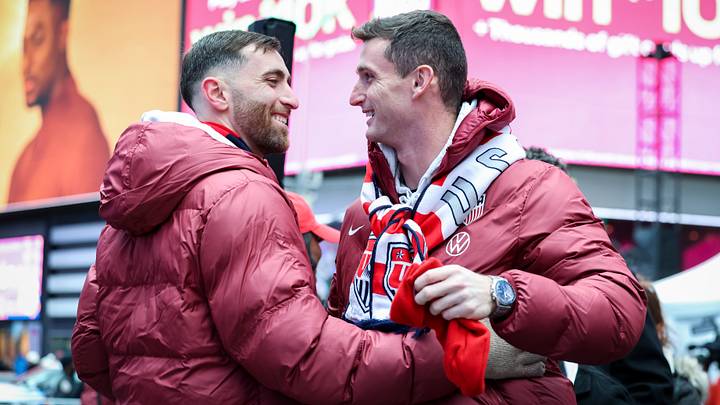
For decades, the goalkeeper position was never a problem for the USMNT — it was one of the great strengths and constants of American soccer.
From Tony Meola’s heroic performances that helped put the United States back on the global map in the 1990s, to Brad Friedel’s world-class consistency across multiple tournaments, Kasey Keller’s ability to perform way beyond his limits, and Tim Howard’s legendary shot-stopping that carried the team through World Cups in 2002, 2006, and 2010. America always had a clear, dependable No. 1 between the posts.
These keepers provided stability, leadership, and big-game performances that fans and teammates could count on year after year. The position was a rock, not a revolving door.
That long era of reliability came to an abrupt end roughly eight years ago. Since around 2018, the USMNT has experienced significant instability in goal.
While Matt Turner stepped up admirably and delivered memorable moments in Qatar 2022 , the position has seen frequent changes, questions over form, club situations affecting confidence, and rotating options that left the backline uncertain. This lack of a settled starter has created unnecessary uncertainty at the most critical position on the field — exactly when the team needs certainty most.
Matt Turner deserves his USMNT flowers, but he's not owed a spot
As the United States prepares to host the 2026 FIFA World Cup on home soil, one position above all others will define whether the USMNT punches above its weight or collapses under the spotlight: goalkeeper.
For years, Matt Turner was the undisputed No. 1 — a hero of the 2022 Qatar campaign with his shot-stopping brilliance and leadership. But times have changed. In 2026, it is no longer a debate. Matt Freese of New York City FC has earned the starting job, and it is essential that head coach Mauricio Pochettino hands it to him without hesitation. Relying on Turner would be a sentimental choice that risks undermining the team’s best chance for success.
Turner was handed the job in 2022 due to a lack of options. The air apparent was Zack Steffen. After not qualifying for the 2018 World Cup in Russia, the U.S. Men’s national team sought to rebuild. Tim Howard, USA’s legendary goalkeeper, was headed to retirement. Brad Guzan was still considered his backup, but his best days were behind him. Steffen had been nurtured, molded and chosen to be the next great U.S. keeper. But club playing time was a concern, as a backup from Manchester City in the Premier League, Steffen barely played.
His confidence took a hit, and he battled injuries sustained in practices. While he was by far and away USA’s best option, he clashed with former national team manager Greg Berhalter. In the end, Berhalter shocked his own squad and the country when he decided to leave Steffen off the World Cup roster and hand the job to a sure-handed Matt Turner, who had very little experience at the time.
Berhalter’s felt Steffen was unreliable. He was worried about the American keeper’s performances while on loan with Middleborough in the EFL Championship. Berhalter heavily criticized his starting keeper. After the snub, Steffen was left shattered and asked for time off to work on his mental health.
Instead of sticking it out with Steffen, Berhalter brought 3 keepers with almost no international experience to the World Cup. Turner had just signed a deal to become Arsenal’s backup keeper. Sean Johnson and Ethan Horvath were career Major League Soccer stars. Despite a lack of experience, Turner stepped up, delivering 2 clean sheets in the group stage against England and Iran. He performed admirably before USA was elimintated by the Netherlands in the round of 16 3-1.
Turner’s decline
Matt Turner, now 31 and back at the New England Revolution, deserves immense respect. He was the rock in Qatar 2022 and earned 53 caps through tireless work. But the data and recent performances tell a different story. After limited minutes across stints at Arsenal, Nottingham Forest, Crystal Palace, and Lyon, Turner returned to MLS in 2025 seeking regular play — yet Freese had already seized the No. 1 role.
In March 2026, Pochettino gave Turner a rare start against Belgium in a World Cup warmup. The result? A 5-2 thrashing in which Turner was beaten five times. While he made five saves, the performance raised serious questions about his readiness at the highest level after inconsistent club time. Analysts noted it did little to reclaim the starting spot and may have even hurt his case as primary backup.
Turner’s club form in 2026 has shown flashes — including shutouts and big saves for the Revs — but it pales in comparison to Freese’s sustained excellence. At 31, Turner is entering the later stages of his prime, while Freese is peaking at the perfect moment for a home World Cup. Selecting Turner as starter would mean ignoring months of evidence that the younger keeper is simply better right now.
Freese! USA has its next star keeper
Matt Freese, 27, has transformed from an unproven backup into the clear frontrunner through sheer consistency and elite-level performances. He burst onto the international scene during the 2025 Concacaf Gold Cup, delivering heroic penalty-shootout saves and starting every match as the USMNT reached the final.
Since then, he has started the vast majority of U.S. matches, including high-stakes friendlies against top opposition like Portugal — where he made several world-class saves and commanded his box with authority.
At club level, Freese’s 2025 MLS season was exceptional: he was a finalist for Goalkeeper of the Year, posted a career-high eight clean sheets, recorded 108 saves, and earned top marks from analysts for his shot-stopping and distribution. Even early in the 2026 MLS campaign, he continues to deliver at NYCFC, facing down stars like Lionel Messi and maintaining high save percentages while playing every week in a competitive environment.
Freese represents the modern goalkeeper the USMNT desperately needs. At 6'3", he dominates the penalty area with presence and athleticism. His distribution is sharp, helping build attacks from the back — a critical requirement in Pochettino’s system. He rarely makes errors leading to goals and has shown composure under pressure that belies his relatively young international career.
The USMNT backline has gelled with Freese in goal. Pochettino has backed him through 2025 and into 2026 for a reason: Freese’s shot-stopping, command of the area, and ability to play out from the back align perfectly with the team’s high-pressing style.
Crucially, Matt Freese has the potential — and is currently showing the form — to restore the historic stability the national team once enjoyed. At 27 and entering his prime, he has demonstrated week-in, week-out consistency at both club and international level that suggests he can be the long-term No. 1 the USMNT needs heading into 2026 and beyond. His emergence symbolizes progress for American soccer: a homegrown talent who rose through the MLS ranks and now stands ready to anchor the side on home soil.
Why its Freese over Turner
With the World Cup just two months away, there is no room for sentiment. Matt Freese has won the job through superior recent performances, consistent club minutes, a modern skill set, and proven reliability under Pochettino.
Matt Turner remains a valuable leader and backup who can contribute if needed, but the starting XI demands the best available goalkeeper today.
Of late, Pochettino has also brought Steffen back into the fold. While it may look like more uncertainty, it isn’t for a lack of confidence in Freese, its a lack of confidence on whether Turner could be a reliable backup. Freese is the keeper who can bring back the stability that defined America’s greatest eras in goal.
 Add us as a preferred source on Google