

I remember being huddled around my laptop back in the summer of 2018, watching as the US, Canada, and Mexico were sitting in front of FIFA's Congress waiting to see if their joint bid to host the 2026 World Cup would be chosen.
When Gianni Infantino announced that the joint bid had beaten Morocco, the delegation popped up to celebrate, and I had dreams of taking my daughter to a World Cup game on home soil.
No wild CONCACAF qualifiers, no odd fields, no hacking fouls on Pulisic. The USMNT were locked in. All we had to worry about was getting better.
Turns out, we were so, so wrong.
Fast forward eight years, and the dream of a home tournament has mutated into a logistical and financial nightmare for the entire world. Fans are fuming over astronomical ticket prices, the hotel industry is sounding the alarm over empty rooms, and unprecedented travel issues threaten to undermine the game we all love.
I was hoping to bring my daughter to a few games this summer, to help her fall in love with the beautiful game the same way I did back in 94. But then reality set in. Even getting the opportunity to buy tickets required navigating a lottery system dominated by bots, resellers, and huge prices. You could better your chances by buying into a better tier, but you weren't guaranteed a chance to buy tickets. And that money was just gone if you don't win a lottery system.
Now, on the secondary market, if I wanted to buy two tickets to the USMNT’s opening game against Paraguay, it would cost me $984.13 per ticket, and those are in the nosebleeds.
That’s $1,800 just to get in the building, before I even factor in gas, which is likely going to be hovering near $5 a gallon by kickoff. What regular fan can afford that? That is literally more expensive than an average month's rent ($1,750).
And apparently, FIFA is late on making payments to people who actually resold on FIFA's official platform.
The pricing war: Apples, oranges, and $33,000 tickets
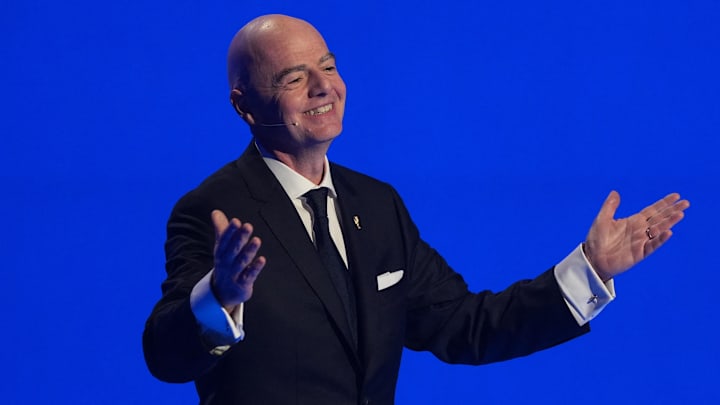
FIFA President Gianni Infantino recently defended the exorbitant pricing by arguing that they simply have to apply "market rates" to the 2026 FIFA World Cup ticket rollout in the U.S.
"We have to look at the market," Infantino argued. "We are in the market in which entertainment is the most developed in the world, so we have to apply market rates... You cannot go to watch in the U.S. a college game, not even speaking about a top professional game of a certain level, for less than $300. And this is the World Cup."
He even went as far as addressing the resale market, noting that if a fan buys a $2 million ticket for the final, he will "personally bring a hot dog and a Coke to make sure that he has a great experience."
It’s an incredibly out-of-touch sentiment, one that former Premier League and Trinidad & Tobago goalkeeper Shaka Hislop rightfully shredded on ESPNFC.
“On one hand, I want to say, I get the phrasing ‘we have to apply market rates,’ but what market are we talking about here?” Hislop countered. “You can't compare a soccer game to what people are willing to pay to go and see an NFL game... New England Revolution can’t charge $300 for a game at Foxborough because that’s not the market."
According to Ticketmaster, the average cost of an MLS ticket is $45-$50. That markup is asinine.
Hislop hit the nail on the head. If FIFA is catering to the ultra-wealthy or expecting bored NFL fans to wander into a soccer match, they might find a few buyers. But treating a $300 baseline as acceptable for international soccer fans is, in Hislop's words, "absolutely preposterous."
“It is not about fans," Hislop added. "It is profiteering off of loyalty.”
The profiteering reaches its absolute peak when you look at the July 19 final at MetLife Stadium. FIFA has tripled the price of its top-tier tickets, with premium seats now listed at a staggering $32,970.
Even President Donald Trump, a man not exactly known for penny-pinching, balked at the prices for the USMNT’s opener against Paraguay, stating bluntly that he “wouldn’t pay it either.”
USMNT legend Alexi Lalas weighed in on FOX News, warning that FIFA risks killing the "golden goose" by pricing out the stands and ruining the perception of the tournament on American soil.
"I would love if all the tickets were free," said Lalas, "And everybody who wanted to go to a World Cup game could... Obviously, that's a little idealistic, and that's certainly not going to happen. I think you'd agree with me that in life and in business, balance is important. And so if the stands aren't full, if it's perceived as not a successful World Cup, FIFA is going to move on..."
"I think this is just a warning to all of us. It's going to be a reflection on me, on you, on the sport of soccer, on our country, and yes, on President Trump... But again, it's going to be a reflection on him, and you don't want to be the guy that messed up the World Cup.
Lalas is right, you have to make money on the World Cup. It is too important to be cheap, but looking at the 2022 World Cup, the US could be seen for under $150 if you didn't mind sitting a little further up, and that's not even at the top. Like it or not, politics is a big part of what happens in soccer; it truly is a global game. But FIFA isn't covering itself in glory right now.
And as the guys at Pardon My Take so eloquently put it: “FIFA does not give a [expletive]. They’re running up the score right now. They don’t care how corrupt you say they are.”
There is a real panic in the hotel industry
You would assume that with tickets hitting five figures, host cities would be bustling. Restaurants and hotels would be filling up, and cities would be making back so much money to cover the costs of being a host city. The reality is much bleaker.
The American Hotel & Lodging Association (AHLA) recently issued a stark warning: nearly 80% of hotel bookings across host cities are running below initial forecasts.
That's not a small dip.
How does the biggest sporting event on the planet result in empty hotels? The AHLA points to two massive culprits: a severe lack of international travelers and massive, last-minute room block cancellations by FIFA itself. The governing body artificially restricted supply, priced out the average consumer, and is now leaving local economies holding the bag. Oops.
We are seeing the data back this up in real-time. As of early May, there were over 47,000 group stage tickets still lingering on the market. The USMNT vs. Paraguay match alone has over 5,300 tickets sitting unsold.
Guys its a home World Cup, how is there even 1,000 tickets left over? I just can't understand how badly this whole thing is being fumbled.
The visa wall and global chaos
The lack of international fans isn't just about ticket prices, though. It's a systemic failure of logistics and diplomacy, and probably was expected with all the issues going on around the globe. International supporters are running into a brick wall trying to enter the country.
- As of January 1, 39 countries faced full or partial visa restrictions. Citizens from nations like Iran, Haiti, and Senegal are largely barred from entry, not being able to see their team.
- FIFA’s Priority Appointment Scheduling System (PASS) was supposed to expedite interviews for ticket holders not in the Visa Waiver Program. In practice, it guarantees nothing and hasn't been as good as advertised.
- Travelers from countries with high overstay rates are being slapped with "visa bonds" of up to $15,000 just to enter the country. Do you know a lot of people who can just drop that?
- Add in the heavy surveillance at the borders, the current unrest in the Middle East, and sudden health anxieties like the Hantavirus concerns, and the prospect of global travel becomes deeply unappealing.
For nations like Haiti (their first World Cup since 1974) or Scotland (their first since the 90s), fans are desperate to see their teams on the global stage. What a moment that would be. Instead, they are met with red tape, exorbitant fees, and outright bans.
And if you can get into the country, good luck going to a fan zone. The places fans used to be able to gather and just watch on a big screen for free, you now have to pay for that, too.
It's hurting the game now, but it's stunting what should be incredible growth.
The stolen generation
When you strip away the corporate speak, the "fiduciary responsibilities," and the hollow promises of a hot dog and a Coke from Gianni Infantino, you are left with a profound sense of loss for the game we all love.
The true beauty of a home World Cup is that an entire generation of kids gets to experience the magic in their own backyard. They get to hear the chants, feel the stadium shake, and fall in love with the game permanently.
Those kids can't afford to be there, my kid can't afford to be there.
Yes, we can all watch it on television. But looking at an empty seat on a screen is a bitter pill; there should be fans in them. This tournament had the potential to be the greatest cultural event in North American history. Instead, it is shaping up to be a masterclass in corporate greed. And it's failing at that, too.
Instead of inspiring the next generation of American soccer fans, the 2026 World Cup is pricing them out before they ever get the chance to fall in love with the game. A home World Cup should belong to the fans. Right now, it barely belongs to them at all.
 Add us as a preferred source on Google