

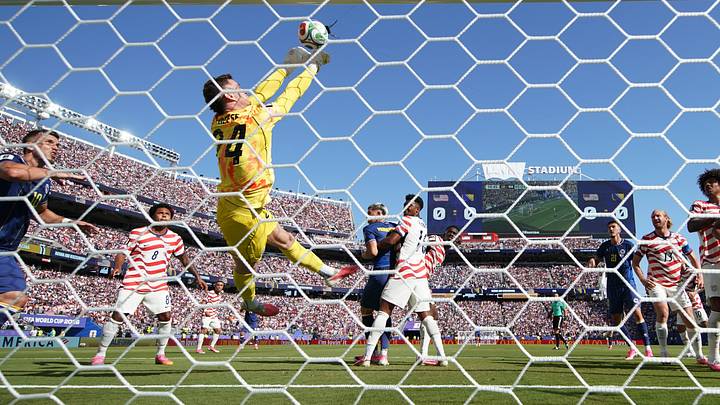
Now that U.S. Soccer has decided to retain Mauricio Pochettino as the USMNT coach, the biggest question in the aftermath of the 2026 World Cup has been answered. That means it’s Pochettino’s responsibility to answer the other pressing question facing the USMNT, which is who will be the team’s goalkeeper during the 2030 World Cup cycle.
Matt Freese was the starter during the World Cup, but during the tournament, he failed to solidify his standing as the No. 1 option moving forward. Even before his monumental mistake against Belgium, Freese had been rather underwhelming in net. His unforgivable folly in the Round of 16 game all but ensured that the goalkeeper position remains unsettled as the 2030 cycle begins in September with four friendly matches.
The two Matts
For the last several years, the USMNT goalie situation has revolved around Freese and Matt Turner. At the 2022 World Cup, Turner was the undisputed starter and looked like a safe bet to continue in that role. But his inability to find consistent playing time at the club level led to a loss of form, opening the door for other goalies. By the time he returned to the New England Revolution and started playing regularly again, Turner looked like a shadow of himself.
During the 2025 Gold Cup, Pochettino gave Freese an opportunity to be the starter. He took it and ran with it. Thanks largely to his three saves in a penalty shootout against Costa Rica in the quarterfinals, Freese took over as the full-time starter. Whenever Turner got opportunities with the national team, he did himself far more harm than good, making Freese the World Cup starter almost by default.
🗣️Matt Freese on playing in the 2030 World Cup:
— Yanks Report (@yanks_reporter) August 9, 2026
"The very obvious focus for me is to be back there in four years. I’m not going to take a breath for four years. I'm not going to stop."
Are we done with Freese? pic.twitter.com/84LddwBCbo
With Turner looking washed up and the memory of Freese’s blunder against Belgium difficult to forget, these might be the most familiar names, but neither can be considered the USMNT starter right now. That position is vacant, and now Pochettino has the task of trying to fill it.
So many options
If there’s a silver lining for Pochettino, it’s that there are plenty of goalkeeping options. The problem is that finding the right one could be like finding a needle in a haystack. There might not even be a perfect option. Nevertheless, Pochettino has to find someone who can be the USMNT’s top-choice goalkeeper for the 2030 World Cup cycle, and the sooner he finds that player, the better.
As the third-string keeper on the World Cup roster, Chris Brady would appear to be near the top of the list of contenders. On the other hand, he’s still just 22 years old despite being the Chicago Fire’s regular starter for multiple seasons. With three caps to his name, Patrick Schulte is also an obvious option. He’s a little older and more experienced than Brady, although that wasn’t enough to put him on the World Cup roster.
MLS has plenty of other young American goalkeepers who might warrant a look from Pochettino at some point. Cincinnati’s Roman Celantano and Inter Miami’s Drake Callender have previously been called into USMNT camp but have yet to play in a game. Both should be on Pochettino’s radar with the new cycle getting underway. Zack Steffen and Ethan Horvath are both experienced goalkeepers, with 30 and 10 USMNT caps, respectively. Both are young enough by goalkeeper standards to still be in the mix for the national team if either can re-establish themselves as a top-flight MLS keeper.
oh no zack steffen pic.twitter.com/LvpeEA3fah
— USMNT Only (@usmntonly) April 4, 2026
Meanwhile, there are a few goalies in Europe who should be on the USMNT radar. Diego Kochen has been a regular for youth national teams over the last several years. He was signed by Barcelona in 2024 and has started to play well while on loan at Lyngby in Denmark. Gaga Slonina has a similar profile, signing with Chelsea in 2022, although he’s been routinely loaned out and struggled to solidify the starting spot at Barnsley during the 2024-25 season. Of course, Kochen is 20, and Slonina is 22, so similar to Brady, their age suggests they may not be a short-term answer for the USMNT.
What’s the plan?
The good news for Pochettino is that he has nearly four years to find a starting goalie for the 2030 World Cup. Of course, the sooner he can identify that goalie, or at least find two or three serious contenders, the better. If the USMNT ends up playing in the 2028 Copa America, it would be great to have the top-choice goalkeeper in place by then to give that player experience in a major tournament before the 2030 World Cup.
It starts in September when the USMNT plays four games in a two-week span. With a two-week camp and four games, Pochettino would be wise to call four goalkeepers into camp, giving each of them a chance to start one of the games. This is the best way to maximize the number of goalkeepers who get to audition for the coaching staff, which is critical in a competition that’s wide open and has a large number of possible candidates.
A FOUR-MATCH WINDOW IS SET FOR THIS FALL!
— U.S. Soccer Men's National Team (@USMNT) August 4, 2026
🇺🇸🆚🇵🇪 - 9/26 in Orlando, FL
🇺🇸🆚🇨🇱 - 9/29 in St. Louis, MO
🇺🇸🆚🇲🇽 - 10/3 in Glendale, AZ
🇺🇸🆚🇨🇦 - 10/6 in St. Paul, MN
🔗 https://t.co/SVoF4Ixmch pic.twitter.com/RwqDMqC4O8
Who should those four goalies be? There are at least a dozen goalkeepers to consider, making it tough for Pochettino to narrow the field down to four. Turner and Freese should be excluded from consideration. While Freese is too young to be ruled out as the USMNT goalie of the future, he’s also a known commodity. These four matches should be about evaluating other goalkeepers in the player pool. Therefore, Pochettino’s selections should be based on a combination of who’s ready to play for the national team and who has a realistic chance to be the starter in 2030.
Based on what happens in the camp, Pochettino will need to find a goalie he trusts to play in the Nations League quarterfinal matches in November. He will also need to plan for next summer’s Gold Cup. The USMNT doesn’t need a full-time goalkeeper in place by the Gold Cup, which will still be three years away from the next World Cup.
Of course, it would be great to find two or three serious contenders for the starting job by this time next year, allowing for the ultimate starter to hopefully emerge at least two years before the 2030 World Cup. While there is no immediate pressure to find a bona fide starter, this isn’t an issue Pochettino and the USMNT want to linger indefinitely.
 Add us as a preferred source on Google