

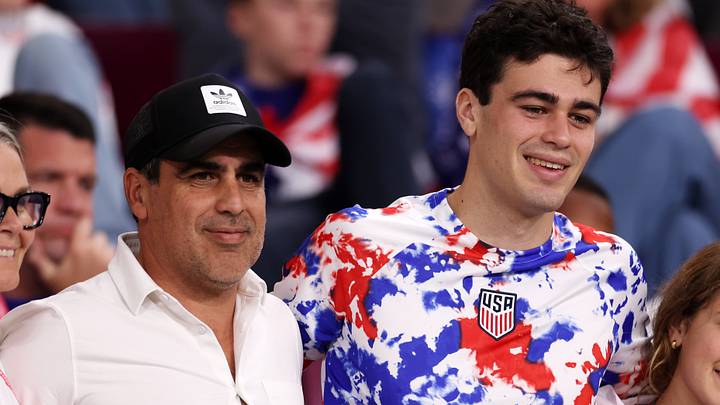
There is a version of Gio Reyna's story that should be one of American football's most compelling narratives. A technically brilliant, naturally gifted attacking midfielder, raised in a footballing household, who reaches his peak years just as the United States co-hosts the greatest sporting event on earth. A home World Cup. A redemption arc. A nation watching.
The problem is that Reyna's story has, for years, been written by everyone except Gio Reyna. It has been written by his father, Claudio, who spent years pestering US Soccer officials on his son's behalf. It has been written by his mother, Danielle, who wielded damaging private information against a family that had been friends with the Reynas for decades. It has been written by injuries that have robbed him of the consistency he needs, and by a 2022 World Cup implosion that turned one of the programme's brightest prospects into one of its most complicated figures.
In 2026, on home soil, with Mauricio Pochettino backing him and a nation desperate to believe in him, Gio Reyna has one chance to finally write it himself. But the past is not yet buried, and the standards being demanded of him this time are unambiguous: produce on the pitch, or go home.
Qatar World Cup: What really happened?
The 2022 World Cup in Qatar should have been Reyna's coming-out party on the global stage. He arrived in Doha as one of the most technically gifted young midfielders in the Bundesliga, a Borussia Dortmund prodigy who had been lighting up European football since he was a teenager. The United States, with a young, ambitious squad, felt like a team in which he could be a transformative force. Instead, he played 52 minutes across two matches, and nearly didn't play at all.
Former head coach Gregg Berhalter said a player was "clearly not meeting expectations on and off the field" — the situation escalating to the point where the USMNT considered sending him home from Qatar, with the player in question ultimately asked to apologise. Multiple reports made clear immediately that the player was Reyna.
After the U.S. loss to the Dutch in the knockout stage, Reyna was reportedly seen wearing a Netherlands jersey in a club. When he eventually broke his silence, he acknowledged the truth: "Just before the World Cup, Coach Berhalter told me that my role at the tournament would be very limited. I was devastated," he wrote on Instagram. "I am someone who plays with pride and passion. Soccer is my life, and I believe in my abilities." He admitted he let his emotions and frustrations overwhelm him.
That, in isolation, might have been forgivable. A 20-year-old, told he would barely play at the biggest tournament of his life, sulking in training — it is not admirable, but it is at least human. What came next was not.
While Gio was sulking in Qatar, his parents were doing considerably worse damage off the pitch — and the independent investigation commissioned by U.S. Soccer laid it all bare in damning detail.
Investigators found that Claudio Reyna had a "pattern of periodic outreach" to U.S. Soccer officials to convey certain complaints and comments about U.S. Soccer's treatment of his children, including primarily his son." That pattern began as early as 2016, when Gio was still a teenager. His behavior was described by one unnamed witness as "inappropriate," "bullying," and "mean-spirited."
Claudio was no ordinary concerned father venting frustration. He was a 112-cap USMNT legend, one of the most decorated American players of his generation, who captained his country at the 2002 and 2006 World Cups. He carried enormous institutional weight inside US Soccer — and the investigation found he had been using it, repeatedly and inappropriately, to agitate for preferential treatment for his son. After Gio did not play in the opening draw against Wales, Claudio sent a text to U.S. Soccer's Brian McBride reading: "Our entire family is disgusted, angry, and done with you guys."
Danielle Reyna's conduct was worse still. After the Wales game, she refused to board the same bus as friends and family of the Berhalters. She then began implying, vocally, that she possessed information that could hurt Berhalter. She was not bluffing. When the pressure reached its peak, Danielle told US Soccer's then-sporting director Ernie Stewart about a 1992 domestic violence incident involving Berhalter, in an apparent attempt to prevent Berhalter from being retained as USMNT head coach — retribution, in essence, for her son's reduced playing time in Qatar.
Her words, as recounted in the investigation, were chilling in their directness: "Once this tournament is over, I can make one phone call and give one interview, and his cool sneakers and bounce passes will be gone."
The independent investigation ultimately found that the Reynas had behaved badly but stopped short of classifying their actions as blackmail. Berhalter was cleared of further wrongdoing beyond the original 1992 incident. But the reputational damage — to the Reyna family, and by extension to Gio — was severe. A family that had been friends with the Berhalters for decades, with Claudio serving as the best man at Gregg's wedding, had let their son's playing time destroy everything.
Claudio Reyna refused to speak to investigators, with the family's attorney instead offering only a "proffer" of information on his behalf. Danielle initially denied having told Stewart about the Berhalter incident at all — before calling investigators back shortly after and changing her story.
"Gio is a player, I think, that can see things that not a lot of others can see. I've already seen that, even just in the early stages of practice. He's a player that I love to have near me."USA teammate Folarin Balogun
Club career? What club career?
Away from the family drama, there is a simpler and equally pressing concern about Gio Reyna heading into 2026: he has barely played football.
Since emerging as one of the Bundesliga's most exciting young talents, things have stalled badly at the club level. Reyna has never really found his place — not at Dortmund, not during a loan spell at Nottingham Forest, and not after moving to Borussia Mönchengladbach last summer in search of more playing time.
Between injuries and an inability to showcase his best form, Reyna made just 19 games this season, with only four Bundesliga starts and a little over 500 minutes across all competitions. At one point earlier in the year, he had logged just 26 minutes in 2026 — not a typo, but a trend. Another muscle injury in January saw him miss Gladbach's match against Stuttgart, continuing a frustrating run of muscular setbacks that have plagued him throughout his career.
The numbers are stark for a player who was supposed to be one of the game's great emerging talents. Reyna has not played over 625 minutes in a single club season since 2020-21. That is five years of a career operating at a fraction of its potential.
And yet Pochettino picked him anyway. The USMNT head coach cited performances in November — a goal in a 2-1 win against Paraguay and an assist in a 5-1 rout of Uruguay — as justification for his faith: "I think he has characteristics that are different and I think I really trust him. I like trusting everyone. But I really trust in him and give him the confidence."
The last chance to rewrite the story
There is genuine talent here. Nobody who has watched Reyna closely disputes that. In 39 caps for the USMNT, he has nine goals and six assists, with half of those 16 goal contributions coming in official games — a record that, given how little he has played, speaks to real quality when fully fit and focused. USMNT striker Folarin Balogun has spoken of what Reyna can do at his best: "Gio is a player, I think, that can see things that not a lot of others can see. I've already seen that, even just in the early stages of practice. He's a player that I love to have near me."
Reyna himself insists he is a changed man: "Obviously, a lot has changed; married now, have a dog," he said recently. "I just like to say, I matured and grown up in many aspects of my life."
Perhaps. But maturity at a World Cup is not demonstrated in press conferences or by owning and caring for a dog. It is demonstrated in the eighty-ninth minute of a knockout match, when the ball falls to your feet, the stadium is shaking, and your country needs you. Reyna himself acknowledges there are no guarantees: "I think it's on everyone's mind. No spot is guaranteed or safe. It's simple. I want to be there. It's a World Cup in your own country."
His father, Claudio, earned 112 caps and captained the USMNT at the 2002 and 2006 World Cups. His mother, Danielle Egan Reyna, won the 1993 NCAA national championship with North Carolina and was a member of the U.S. Women's National Team. The Reyna name carries extraordinary weight in the history of American football. For years, that legacy has been both Gio's greatest asset and his most suffocating burden.
At the 2026 World Cup, played on American soil, in stadiums packed with American supporters who want desperately to believe in him, that name means nothing. Claudio cannot pick up the phone to Pochettino. Danielle cannot make a scene in the family stand. The independent investigators have long since closed their files.
All that remains is a 23-year-old attacking midfielder with the talent to be special and the history to be complicated, standing in front of the world with no one to hide behind and no one to blame.
It is, finally, just Gio. And that is exactly how it should be.
 Add us as a preferred source on Google