

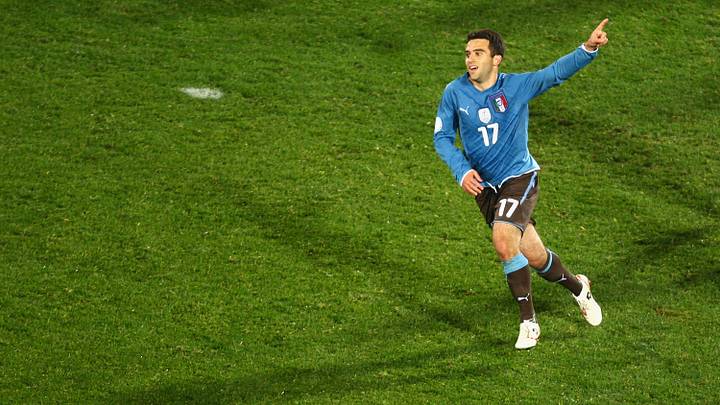
There is a particular kind of heartbreak reserved for American soccer fans of a certain generation — those who lived through the lean years, who watched the U.S. Men's National Team scrape and claw for respect on a global stage, where it was barely taken seriously. It is the heartbreak of Giuseppe Rossi. Or, more precisely, the heartbreak of what Giuseppe Rossi might have been had he chosen a different flag to pull over his head.
The argument is not subtle. Had Rossi — Clifton, New Jersey's own — suited up in red, white, and blue instead of the Azzurri blue, he very likely would have been the greatest player in the history of the United States Men's National Team. Not marginally. Not by a sliver. By a country mile.
But before we mourn what never was, we need to understand why it never could have been. Because the story of Giuseppe Rossi is not simply a tale of a talented kid who turned his back on America. It is the story of a culture, a family, a neighborhood, and a football identity that made the choice almost inevitable before the kid was old enough to make it himself.
Clifton, New Jersey: Where Italy never left
To understand Giuseppe Rossi, you need to understand Clifton. Nestled in Passaic County, Clifton has long been one of the most densely Italian-American communities in New Jersey — a state that itself is one of the most Italian-American in the nation. These were families who brought the old country with them across the Atlantic, who maintained its language at the dinner table, its food in the kitchen, and its football on the television set.
In a household like the Rossis', there was no MLS to follow. The league didn't even exist until 1996, and even then, it spent years struggling to find a foothold in the American sporting consciousness. There was certainly no Premier League streaming package, no La Liga highlights on demand.
What there was, on grainy satellite feeds or if you were lucky, like Giuseppe was, Channel 31 ran a delayed feed of RAI, Italy's largest network. That feed would play all week long, and it's where most Italian-American children learned about calcio (The Italian word for football or soccer).
Most Italian-American neighborhoods would have a newsstand selling Oggi with a large pink insert featuring La Gazzetta dello Sport. It was in the back pages of Italian-language newspapers where Serie A came to life. Juventus. Milan. Inter. Roma. Napoli. These were the clubs that mattered. These were the names that echoed in living rooms from Clifton to Bensonhurst to South Philadelphia.
Above all clubs, above all competitions, there was the Squadra Azzurri — the Italian national team. For Italian-American families of that era, the Azzurri were not a foreign team. They were the team. The World Cup was not a sporting event; it was a cultural referendum, a month every four years when Italian-American identity went from background hum to full-throated roar. Kids wore Italian jerseys. Flags hung from car windows. Restaurant televisions flickered with the action from wherever the tournament was hosted.
Rossi has spoken about all of this with remarkable clarity. "My family, they're all Italians," he said in one interview. "My parents came here when they were 15 or 16 years old. Obviously, my first language when I was born was Italian. I grew up in a household speaking a lot of Italian. When it came to soccer, I used to watch Milan. I used to watch la Serie A. I used to watch the Italian national team because that's what I grew up watching — that's what I grew up falling in love with."
The passion was lit earliest by his father, Fernando, a teacher and soccer coach at Clifton High School. "The passion I have for the game came from my father," Rossi has said. "One hundred percent. He was born in Italy. He was a huge Milan fan, and I grew up being a Milan fan also. We used to wake up at 9 o'clock in the morning every Sunday, catch the games, go out in the backyard every day, kick the ball around. He used to come back from work for lunch, put a couple of cones around and I would always be dribbling in between them. I was 2 years old, so it was in my blood since I was that young."
For a boy growing up in that world — born in 1987, raised in Clifton through the 1990s — the USMNT was, to put it plainly, an afterthought. The Americans were not a team that stirred the blood. They were a team that occasionally appeared at the World Cup and was politely applauded for showing up.
It is worth pausing here to acknowledge the one moment when American soccer genuinely broke through: the 1994 World Cup, hosted on home soil. For a brief, glorious summer, soccer captured the imagination of a nation that had largely ignored it. Stadiums were packed. The streets hummed. An entire generation of kids kicked balls around in backyards with a new kind of urgency.
Giuseppe Rossi was just seven years old.
The 1994 tournament planted seeds — MLS was its direct offspring — but for an Italian-American kid in Clifton, it did not rewrite the cultural script. His parents still watched Serie A. His extended family still lived and died with the Azzurri. The World Cup on American soil was thrilling, but it did not transform the soccer identity of Italian-American households overnight. That identity was generational, layered, and deep-rooted in a way that a single tournament — even one played down the road in Giants Stadium — could not undo.
By the time American soccer had anything resembling a genuine domestic culture worth belonging to, Rossi was already gone. At age 12, he packed his bags and moved to Italy to join the youth academy at Parma. The choice was made not by a teenager weighing national team options, but by a family following football gravity — the natural pull of a culture that had always pointed toward Italy.
The making of Pepito
What Rossi did after leaving Clifton was remarkable by any measure. He rose through Parma's academy, caught the eye of Sir Alex Ferguson, and joined Manchester United in 2004. He made his first-team debut at Old Trafford before moving on loan and then permanently to Villarreal in Spain, where he became the club's all-time leading scorer with 82 goals in 192 appearances.
His peak was extraordinary. In the 2010-11 season, he scored 32 goals in all competitions, leading Villarreal to the Champions League and prompting serious transfer interest from Barcelona — Barcelona — before injury intervened and changed everything. He was, in that window, one of the most dangerous forwards in European football: quick, technically refined, a left foot like a blade, with the intelligence and movement of a player schooled in the highest traditions of the game.
He made his Italy debut in 2008 and went on to earn 30 caps, scoring seven goals. He played in the 2009 FIFA Confederations Cup, where — in a moment that still stings a certain section of American supporters — he scored twice against the United States in a group-stage match and celebrated with evident relish. If there had been any ambiguity about where his loyalties lay, that afternoon in Pretoria erased it.
What would Giuseppe Rossi have meant to the United States Men's National Team?
The USMNT, for all its progress over the decades, has never had a striker of genuine world-class pedigree playing in the prime of his powers. Clint Dempsey was a brilliant footballer — technical, tough, a scorer of important goals — but he was a different kind of player, less a pure finisher than a creator and battler. Landon Donovan was one of America's greatest ever, a player of craft and clutch moments, but again, not a penalty-area predator of the kind that elite international teams are built around.
Rossi, even in his diminished form, was that kind of striker. At his peak, he was the kind of player who scored hat tricks against Juventus, which he literally did for Fiorentina, netting three goals in 14 minutes to turn a 4-2 deficit into a 5-4 win, in one of the most dazzling individual performances Serie A had seen in years. He was a player Barcelona wanted to buy. He led La Liga in scoring. He was, before his knees betrayed him, a player who could have performed at the very summit of the world game.
Had he played for the United States from his debut at Villarreal through his peak years, American soccer history looks entirely different. The 2010 World Cup — where the U.S. reached the Round of 16 — becomes something more with a world-class striker in the lineup. The 2014 tournament, a creditable if ultimately disappointing run, might have ended differently. For a program that has always been searching for that elite-level finisher, Rossi would have been transformative.
His agent, in 2016, said as much. Speaking to Radio Bruno, agent Andrea Pastorello offered a candid admission: "In hindsight, going back to when he chose between representing Italy or the USA, we should have chosen the USA." The implication was clear — had Rossi played for the Americans, he might have been the unquestioned star of a program rather than a perpetual injury absentee on the fringes of a deeper squad.
Rossi himself, characteristically, refused to accept that framing. "It is something that I never said," he responded flatly. "It's something I never thought. It was always Italy from day one."
And yet — and this is important — we cannot truly blame Rossi for the choice he made. Asking a boy raised in an Italian-American household in 1990s New Jersey, steeped in Serie A and the Azzurri, to choose the USMNT over Italy is a bit like asking someone to turn their back on the language spoken in their home. The choice was cultural long before it was ever tactical.
Rossi has been emphatic on this point, pushing back firmly against any framing of it as a difficult decision or a close call. "I understand where they came from in America, trying to get a young player to play, but there was never really a part of me that said, 'Okay, I have to choose' — because my choice was already made since I was a kid," he said.
"When I talk about being a kid, I mean seven or eight years old, watching the World Cup and the Italian national team play. My father took me to watch the Italian national team play against Ireland, and that's a memory I'll cherish forever. Waking up every Sunday at 9 a.m., throwing on my Milan jersey and watching Milan play, that was something that was built into me as a kid. So, when I did have a decision to make, it wasn't a decision. I knew what I wanted since Day 1. I never hesitated and never wanted anything different."
In another interview, he was even more direct: "My mind was made up already when I was 2 years old — it wasn't something I made up when I was 18 years old. I just hope people understand that. I know there's a lot of people that don't want to understand it."
The United States soccer program was, for most of Rossi's formative years, barely registering. The USMNT qualified for the 1990 World Cup for the first time since 1950, hosted in 1994, and began slowly building something real — but "slowly building something real" does not compete with the pull of Gli Azzurri in the consciousness of an Italian-American family. Every Italian-American kid growing up before the MLS era was rooting for Italy. Full stop. That's not disloyalty to America; it's the natural expression of a dual identity in which soccer had always belonged to the old country.
Fernando Rossi, who spent 23 seasons building Clifton High's soccer program into a regional powerhouse, was the single greatest influence on his son's football life — and on the choice that would define it. "People have to understand that it was a natural thing for Giuseppe to say he wanted to play for Italy," Fernando said before his death. "Why? Because he grew up soccer-wise when he moved there at 12 years old. He went to school with the kids and went through every level in the national team. So it's natural to say I want to play in Italy, with no disrespect for where he was born."
Fernando died in February 2010 at age 60, and his loss cut Giuseppe deeply. Later that year, when Rossi scored for Italy in a friendly against Germany, he addressed the cameras afterward: "I dedicate it to my father, who died last year." The man who had set up cones in the backyard, who had pulled in Serie A on the satellite dish, who had taken his son to watch the Azzurri play in person — he was gone. But what he had built in his son, that fierce Italian football identity forged in a New Jersey backyard, was permanent.
Bruce Arena, then the U.S. coach, famously said after Rossi declined a pre-World Cup call-up in 2006: "We're not chasing around 18-year-old players that can't make up their mind." It was a proud statement, perhaps a correct one. But it also acknowledged the reality: the U.S. program, as late as 2006, was not the kind of proposition that automatically outbid Italy in the hearts of Italian-American players.
For American fans, he is the great ghost — the what-if that will never be resolved. The greatest USMNT player who never played for the USMNT. The kid from Clifton who belonged to Italy. It was always going to be Italy. In that house, in that neighborhood, in that era, with that name — it was never going to be anything else.
 Add us as a preferred source on Google